Filling the weapons gap and increasing platform firepower
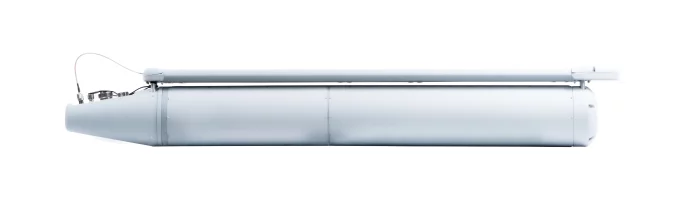
The U.S. Government’s only program of record for 2.75”/70mm guided rockets, our APKWS guidance kit transforms unguided 2.75-inch (70 millimeter) rockets like the Hydra 70 Mk 66 and others into precision-guided munitions (PGMs). Qualified on numerous U.S. Department of War (DoW) platforms, APKWS laser guidance kits provide affordable surgical-strike capability to multiple rotary-wing and fixed-wing platforms, as well as unmanned aerial vehicles, static and mounted ground platforms, and maritime vessels.
The APKWS system bridges the gap between unguided rockets and larger anti-armor munitions with commonality across the U.S. military services – Navy, Marine Corps, Army, and Air Force. The APKWS system consistently delivers pinpoint accuracy for the highest lethality available against soft and lightly-armored targets at a lower cost than other systems.
Greater strike range with unmatched precision lethality
With the category’s highest combat-proven hit rate, APKWS guidance kit equipped rocket consistently hit their intended target with pinpoint accuracy while limiting collateral damage. The guidance section is designed to lock onto targets from over 6 kilometers away, supporting survivability and mission success by keeping your launch platform at a safe standoff distance from threats. The guidance kit’s Single Variant Block Upgrade optimized flight trajectory so the rocket can hit targets at a steeper angle of attack for enhanced lethality.
Innovative by design, the APKWS kit includes advanced Distributed Aperture Semi-Active Laser Seeker (DASALS) optics located on all four guidance wings, which are protected by wing-slot seals prior to firing, avoiding adjacent fire damage that can interfere with a nose mount seeker. Once the rocket is fired, the APKWS kit’s wings deploy and the optics lock on to designated targets, guiding the rocket to the target – delivering accurate strikes and minimizing collateral damage when and where it matters most.
- Wing slot seals protect optics from adjacent firings, sand, and moisture prior to launch to ensure no damage or debris inhibit the seeker from locking onto targets
- Optics lock on to moving or stationary targets in open or confined areas, supporting a wide variety of missions, and reducing any chance of a lost or uncontrolled rocket after launch
- 40-degree instantaneous field of regard enables a broad capture area for the rocket to adjust mid-flight and stay on track to its target
Cost effective, easy to integrate, and more capable than ever
First put into production in 2008, the APKWS laser-guidance kit proved to be one of the most accurate, effective, and easy to implement systems in the world for converting unguided rockets into laser-guided rockets (LGR). Today’s system has also proven itself capable in air-to-air targeting of unmanned aerial vehicles (UAVs) and low-flying cruise missiles – as part of a counter-unmanned aerial system (C-UAS) – as well as in ground-to-ground lethality fired from launchers mounted on vehicles and remote weapon stations.
Mission and platform flexibility, as well as its light weight and low cost of integration, makes our APKWS system one of the most highly capable and useful combat weapons available to every department of the U.S. DoW and to U.S. allies. In fact, since its introduction, over 100,000 APKWS units have been sold for service worldwide.
Production-ready for high demand
APKWS guidance kits are readily available. Demand from the U.S. military and international governments is high, and BAE Systems is well-positioned to support that demand. Our state-of-the-art factories in Hudson, New Hampshire and Austin, Texas continue to produce and deliver with available excess capacity, supported by our robust supply chain, advanced manufacturing capabilities, and recent investments of over $100 million in infrastructure improvements. We offer a manufacturing capacity of at least 25,000 units per year, and are continuing to expand production.
With most of our supply chain in the United States, our centralized approach, and focus on delivering zero defects, we are optimizing overall production and delivery efficiency, which shows in our:
- Over 12 years in full-rate production
- More than 100,000 units delivered to date
- Proven ability to surge capacity, accelerating the delivery of over a thousand units ahead of schedule.
With the lowest acquisition, operational and maintenance cost of any 70-ton capable recovery system, HERCULES answers the need for cost-effective, self-supporting heavy recovery performance.
The HERCULES was the primary 70-ton recovery system during Operation Iraqi Freedom. And, U.S. troops found a few other creative uses for its capabilities when they used it to pull down the Saddam Hussein statue in Baghdad on April 9, 2003. HERCULES uses a hull designed for the recovery mission and thoroughly proven by U.S. Army testing. Stability and performance are unmatched by any alternate tank-based design.
HERCULES offers operational and logistics commonality with the existing M88A1 fleet, simplifying training and parts availability. Key upgrades include improved power-assisted braking, improved steering, improved electrical system and increased engine horsepower.
HERCULES features overlay armor protection, ballistic skirts, a longer 35-ton boom, a 140,000-pound (63,504 kg) constant pull main winch with 280 feet of cable, and an auxiliary three-ton winch to aid main winch cable deployment. The M88A2 HERCULES is built and equipped to be the world's recovery champion.
Digital Directory